
 Ask an Engineer
Tolomatic’s Force Calculator Takes the Guesswork Out of Hydraulic-to-Electric Conversion
By John Fenske on August 11, 2026
Replacing a hydraulic cylinder with an electric actuator starts with a critical question: how much force does the existing system actually produce? Without an accurate answer, you’re either over-specifying an actuator and paying for capacity you don’t use, or under-specifying it and running into performance challenges after installation. Tolomatic’s online Hydraulic-to-Electric Conversion Force Calculator lets you quickly calculate the force early in the conversion process.
Hydraulic Conversion Force Calculator
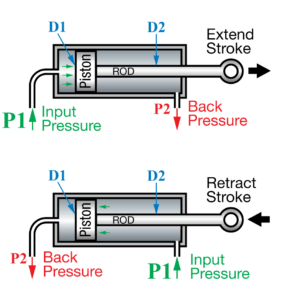
The Force Calculator estimates the force output of a single hydraulic cylinder based on the bore diameter (D1), rod diameter (D2), input pressure (P1) and back pressure (P2). It returns the applied force when extending (F1) and retracting (F2).
To obtain the most accurate results, measure pressure at the cylinder or as close to it as possible, rather than at locations farther upstream or downstream. The closer your measurement is to the point of work, the closer your force estimate will be to actual operating conditions. If you can’t obtain an input pressure, use the system pressure for P1. If you don’t know the back pressure, enter zero for P2. The calculator also returns a suggested electric actuator based on the calculated force.
Hydraulic Conversion in Three Easy Steps
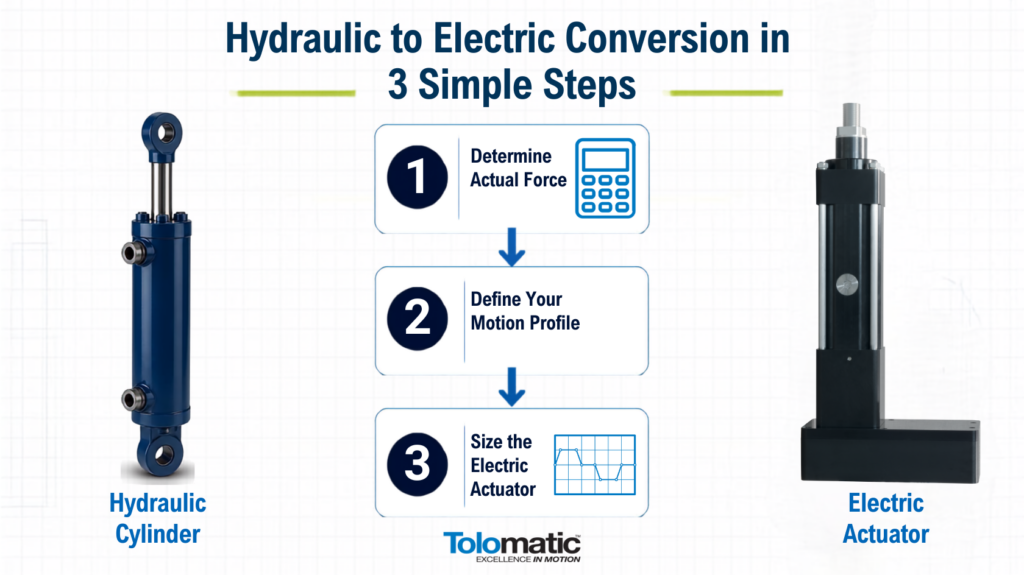
Knowing the true force requirement is the first step in the three-step process of converting hydraulic systems to electric actuation. After determining your force, define your motion profile and then use sizing software to select the optimal actuator based on force and motion specifications.
With hydraulic cylinders, the force produced depends on bore area, rod area and the actual operating pressures (most accurately measured at the cylinder ports). Engineers know that real operating conditions often differ from the original design, which is why the Force Calculator provides a direct check against actual measurements instead of relying on rated specifications. Learn more about hydraulic conversion in our white paper, “Making the Jump to Electric”.
Improving Total Cost of Ownership
A major benefit of electric actuators is that they reduce the total cost of ownership compared to a hydraulic system. This may not seem to be the case at first, considering the generally lower initial cost of a hydraulic cylinder compared to its electric counterpart. However, after factoring in the total costs associated with installation, energy consumption, fluid disposal and potential environmental impact, electric actuation is much more cost-effective overall.
Several of those costs carry significant weight:
- Efficiency: Electric actuator systems typically operate at 75-80% efficiency; hydraulic systems typically realize 40-55%.
- Utility costs: Because of lower efficiency, hydraulic actuators can consume two to three times as much energy as an equivalent electric actuator system.
- Life estimation: Electric actuator service life can be calculated using an L10 dynamic load rating; hydraulic cylinder life is difficult to predict.
- Data collection: Servo systems driving electric actuators provide position, velocity and force/torque data continuously to the control system.
- Environmental exposure: Hydraulic systems will leak over time, creating both safety hazards and environmental liabilities.
Products Built for Hydraulic Conversions
Tolomatic’s electric rod actuator line covers a broad force range. The RSX series reaches forces up to 100,000 lbf (445 kN) and is built specifically for hydraulic replacement applications. The RSA series addresses general motion control, valve actuation and punch press work. For food, beverage and pharmaceutical applications, the RSH hygienic actuator with 316 stainless steel construction and an IP69K rating produces forces up to 7,943 lbf (35.3 kN). The IMA, which integrates a servo motor in a single compact unit, reaches up to 8,000 lbf (35.8 kN).
Visit Tolomatic’s hydraulic conversion resource page and use the Force Calculator to see what forces your hydraulic system produces.