
 Ask an Engineer
4 Business Cases for Hygienic Electric Actuators in Food Processing Equipment
By John Fenske on November 17, 2026
Food manufacturers are demanding cleaner, safer machine designs from their OEM machine builders, and the pressure is high in meat, cheese, dairy, seafood and poultry processing. A recall means fines, lawsuits, adverse publicity and lost production, so every component inside a wet-side machine comes under scrutiny. Electric linear actuators bring no air, no oil and no leaks — just clean, consistent control.
Here are four applications that show what that switch looks like on a production floor. Two displaced fluid power, two replaced mechanical adjustment, and all four run through routine washdown.
Changeover Time Reductions Boost Productivity on Filling Line
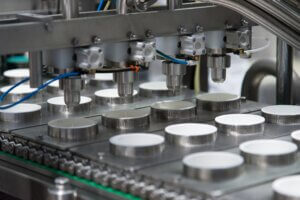
An inline filling machine needed the speed and flexibility to handle a range of container sizes and shapes. Its mechanical cams could not manage that range without a physical changeover. The filling unit sits 10 mm above the container, then travels down 20 mm within 0.5 seconds to dip 10 mm into the product. The remaining 200 mm of the 8.7 in (220 mm) stroke reaches the cleaning position and covers different container heights.
An IMA-ST33 hygienic motor/actuator, built to order with strokes up to 18 in (457 mm) and speeds up to 20 in/sec (500 mm/sec), covered the requirement with margin. Because it mounts vertically, the unit includes an integrated brake for safety, and changeover no longer means swapping cams and stops.
Cheese Cutting Without the Contamination Risk
A cheese company ran several cutting stations on hydraulic cylinders, which can leak high-pressure fluid and contaminate the product. Food-grade oil is only a partial solution because it stays in the system long enough to become dirty. Tighter food safety requirements made that risk unacceptable, though the company had come to depend on the long life that hydraulics delivered.
An RSH30 hygienic electric actuator — all stainless steel, IP69K rated, with a pre-mounted servo motor — replaced its hydraulics, producing 4,000 lbf over a 40-inch stroke. Driven by a roller screw, the RSH30 matched the service life the company had relied on, and electric actuation reduced utility costs.
Dispensing Lane Gains Speed and Accuracy
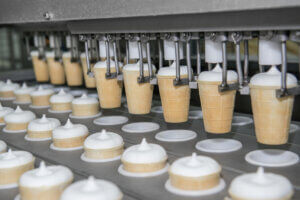
A producer of frozen entrées needed faster fill speed and better fill accuracy than its pneumatic filling equipment could deliver. Pneumatic cylinders typically have only two positions, require manual adjustment when the stroke changes and depend on clean, filtered, dry air. A tall order in plants with frequent washdowns and hot-cold temperature swings that create condensation.
Eight ERD20 rod-style screw-drive actuators, one per dispensing head, replaced the pneumatics. They provide stainless steel construction and IP69K ingress protection for clean-in-place washdown, plus 150 lbf of pumping force over an 8-inch stroke. Variable stroke lengths with control over acceleration and deceleration decreased overfills, and retiring the hand cranks removed a source of human error. Tolomatic’s Your Motor Here® tool matched the customer-specified Allen-Bradley motors, so the system dropped into a line already running.
Multiple Lane Stacker with Improved Food Safety, Throughput and Quality
In one factory, stacking equipment for meat and vegetable patties, waffles and pancakes indexes each of six lanes independently. Indexing speed and accuracy are critical: they drive throughput and determine whether the product holds its formation. And every key component needed an IP69K rating because the equipment sees aggressive, regular washdowns.
A bank of six ERD20-SS2 stainless steel actuators with servo motors now drives the indexing. Pairing JVL servo drives with the existing Allen Bradley PLC reduced integration cost and design time. Controlling the indexing speed also keeps the product from deforming.
The Design Practices Behind the Results
These four applications share several design decisions.
IP69K is the baseline. The rating is best practice for the food and beverage environment. The hardest part of meeting it is the seal on the thrust rod. Seals wear during operation, so tight dimensional tolerances and proper seal design hold the rating across many cycles.
Stainless steel for bodies, housings and fasteners. Corrosion resistance makes stainless steel one of the best materials for hygienic design. Stainless steel construction also lets designers use an open-frame architecture instead of hiding components inside large enclosures that add cost and maintenance.
Constructed for easy cleaning. An ingress rating keeps water out, but geometry is what makes the washdown itself effective. Hygienic actuators featuring smooth surfaces and rounded bodies, keep moisture, food particles and microorganisms from collecting and pooling. This construction ensures particles and sanitary solutions drain off instead of lingering on the actuator after cleaning.
Read our white paper on best practices for designing electric actuators into food processing equipment, or contact our application engineering team to discuss your requirements.